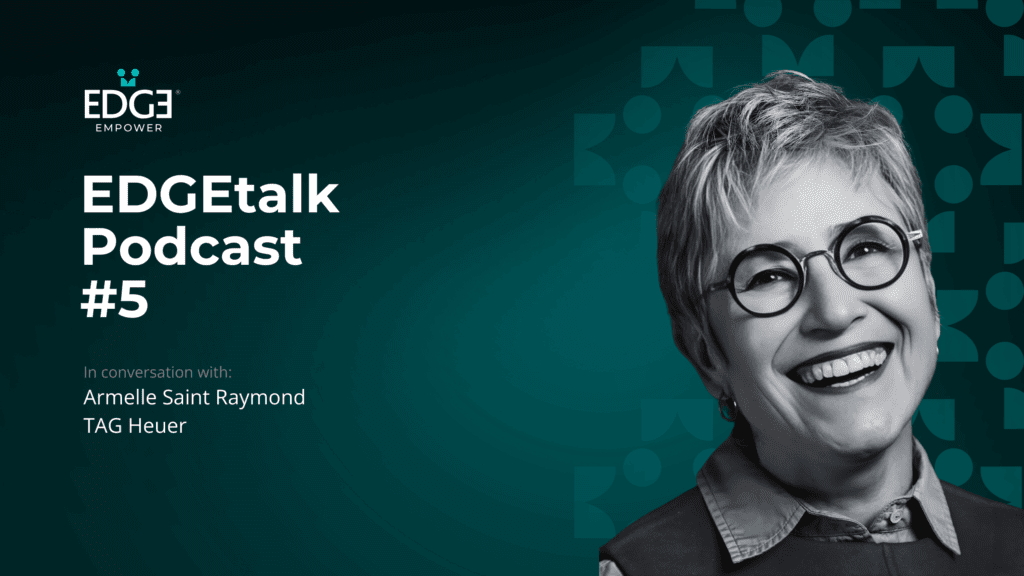
For Armelle Saint Raymond, Chief Human Resources Officer at TAG Heuer, the case for diversity and inclusion is not about doing what is right; it is about doing what works. In a conversation that moves seamlessly between the personal and the professional, she reveals how her family shaped her values, why she believes an organization must mirror its customers, and what it truly takes to transform a corporate culture: not grand gestures or defensive postures, but an inclusive leadership approach and the steady, patient work of building something that endures.
When Armelle Saint Raymond speaks about diversity and inclusive leadership, she does not begin with corporate frameworks or strategic imperatives. She begins with the story of her mother, a teacher for children with hearing impairments, who gave her her first lesson in valuing differences. Then she speaks of her husband, who brought a different culture and a different religion than hers into their marriage—and of the decision they made together to raise their children so as to give them “the opportunity to see the plurality of the world.”
And then there is her daughter: part of the LGB community, fiercely feminist, for whom equality is not an abstract principle but a daily battle. “All my family taught me how to be a better person,” Armelle reflects. “More open, more tolerant, and more open to diversity.”
From personal values to professional purpose
It is a disarmingly personal way to frame a conversation about workplace inclusion. But for Armelle, who has spent three decades in senior HR roles across consumer industries—much of that time in family-controlled businesses and in the midst of complex organizational transformations—the personal and the professional have never been separate domains. “We’re human first,” she says simply. “I bring the person I am into my job. I can’t do it differently.”
That philosophy has shaped her approach as CHRO at TAG Heuer, where building an inclusive culture has become, in her words, “the most important thing I do.”
Beyond morality: the performance case for inclusion
In a climate where some organizations are quietly scaling back their commitments to diversity and inclusion, Armelle’s position is both pragmatic and unequivocal. She does not frame inclusion as a moral obligation or a matter of corporate duty. Instead, she makes a case for inclusive leadership rooted squarely in business performance.
“There have been a lot of studies that demonstrate in a very scientific way that inclusive environments are more likely to bring innovation and creativity,” she explains. “When you put around the table different people who think differently, who have a different vision of the world, it’s much more creative. But I’m also certain that if you have diverse people taking decisions around the table, it’s the best way to take good decisions.”
The distinction matters, she argues, particularly when seeking buy-in from business leaders who may be skeptical of initiatives perceived as disconnected from commercial realities. “I don’t bring DE&I as a moral requirement or as a duty. It’s not a question of morality. It’s a question of performance. And this is the best way to be heard by our leaders.”
There is also the question of talent attraction and retention. Younger generations, in particular, are drawn to organizations with inclusive cultures and are increasingly unwilling to compromise on personal values when choosing an employer. In a competitive market for skilled professionals, being recognized as a champion of diversity, equity, and inclusion becomes a powerful lever for employer branding. “So again, we’re talking about performance,” Armelle says. “And it’s most of the time my best argument in front of CEOs.”
It’s not a question of morality—it’s a question of performance. If you talk about performance, leaders are more ready to listen.”
Armelle Saint Raymond
The mirror principle: why your workforce must reflect your customers
At TAG Heuer, the business case for diversity takes on a very concrete dimension. The Swiss luxury watchmaker sells its timepieces across the globe: in Europe, but also in China, Korea, Japan, the United States, Latin America, and beyond. Its customer base is inherently diverse, spanning cultures, generations, and genders. The logic, for Armelle, is inescapable: inclusive leadership requires an organisation’s internal composition to mirror the people it serves.
“If we have a European-centric vision, we will never address the expectations and wishes of our Chinese or Japanese customers,” she observes. “Having a diversity of profiles within our headquarters team, in marketing and product, helps us understand in a very intimate way what our customers want. They are diverse by essence. So it’s not a nice to have. It’s a must.”
Today, approximately 15 per cent of TAG Heuer’s net sales come from female customers, and the company is aiming to increase that share to 30 per cent. Having women in product and design teams—including a female Chief Product Officer—is not merely symbolic; it is strategic. “Of course it helps to understand in a more intimate way the wishes and expectations of female customers,” Armelle says. “Our internal organization has to be a mirror of our customers.”
Generational diversity is equally essential. TAG Heuer’s core customer base has traditionally been over the age of 45, but the company is actively pursuing younger clients. With four generations currently represented in its workforce, the organization is better positioned to understand and engage these emerging audiences. “The aspirations of the youngest generation, you cannot fully capture them if you are over 50,” Armelle acknowledges with characteristic candor. “We need to have those people in our teams.”
Our internal organisation has to be a mirror of our customers. It’s not a nice to have—it’s a must.”
Armelle Saint Raymond
From conviction to culture: making inclusion real
Translating conviction into cultural change requires more than compelling arguments. At TAG Heuer, Armelle and her team have invested heavily in education, designing workshops that bring the realities of workplace discrimination into sharp focus for employees at every level of the organization.
Before launching the programme, employees were invited to share testimonies of discrimination they had witnessed—not dramatic incidents, but the small, daily microaggressions that accumulate over time and erode both individual wellbeing and team cohesion. These real examples, collected anonymously, became the foundation of a training programme delivered to top management, middle managers, and frontline employees alike.
“The power of this workshop was that we designed it based on real life,” Armelle explains. “We told them: this is not a fictitious example or an example from another company. This happened at TAG Heuer.” The objective was to help people recognize what microaggressions look like and understand how they can act at their own level. “Because everybody can do something.”
Beyond awareness, the aim is activation: equipping employees to become allies who intervene when they witness exclusionary behaviour is central to inclusive leadership. TAG Heuer has also established a champions community—a network of employees across departments who actively promote diversity and inclusion while serving as an early warning system, raising concerns before they escalate into larger issues.
Measurement, accountability, and the value of external validation
For TAG Heuer, the partnership with EDGE has brought both structure and credibility to its inclusion journey. The certification process required the organization to address dimensions of diversity and inclusion it had not previously considered, broadening its perspective through the rigor of independent, third-party assessment.
“It provides us with guidance,” Armelle says. “Some aspects we never took into consideration came up during the EDGE process. It also allows us to measure progress, because every two years you can see where you stand. And you do not progress if you cannot measure.”
The certification has prompted tangible changes. Proactive management of gender pay equity is now firmly on the roadmap, alongside the ambition to reach 30 per cent gender representation in management.
The process has also led the company to revisit existing programmes. “We have a mentoring programme that was open to a certain portion of the population,” Armelle recounts. “After discussions with EDGE, we realized it was not inclusive enough; it was actually more of an exclusive programme. So we reviewed it to ensure it gives opportunity for all.”
External validation, she notes, plays a crucial role. “It’s not possible to pretend by ourselves that we are the champions of diversity, equity, and inclusion. It has to be said by a third party. We need that external validation to strengthen our position and give credibility outside the organization.”
The long game: patience, humility, and small victories
Asked what advice she would offer to organizations beginning their own inclusion journeys, Armelle’s response is pragmatic and grounded in experience. Cultural transformation, she insists, is never a revolution. It is the accumulation of incremental gains, each one building upon the last.
“It’s very important to be super humble and to accept implementing small things at the beginning,” she says. “Because you do not change a culture in five minutes. It takes time to install an inclusive culture, so you have to be very patient.”
“Sometimes you win very small battles, but it’s okay. Because at the end, small battles after small battles make a big victory. Start small and be patient. It’s the only way to change a culture.”
At TAG Heuer—a company built on precision and the mastery of time—that philosophy feels particularly fitting. Change, like fine watchmaking, is a craft that rewards those who understand that the most enduring results are achieved not through haste, but through care, persistence, and an unwavering commitment to getting the details right.
Start small and be patient. It’s the only way to change a culture.”
Armelle Saint Raymond
TAG Heuer is not alone in this approach. Other organisations, from global sports retailers to international manufacturers, know that inclusion drives measurable business outcomes.